Well-known Konkani writer Stan Ageira’s anthology of short stories ‘Cathillaacho Anamik’ has been selected for the prestigious Dr TMA Pai Appreciation Award for 2021. The award carries Rs 10000 and citation. This was announced recently by the foundation in Manipal.
The book was published by Udupi diocese’s Uzvaad Prakashan.
A prolific writer in Konkani, Stan Ageira from Mulki has written 18 novels and over 250 short stories.
Over 50 short stories are translated to Kannada, Telugu and English.
Woman’s Era from New Delhi have been regularly publishing his stories in English for over 20 years. His collection of short stories ‘Tea, Coffee and Cheesecake’ was published by US based Raider publication.
He is recipient of several literature awards including twice Karnataka Sahitya Academy Award.
His short stories are available online under the Red Chillis column in Daijiworld.
Konkani poems, ‘Gayathri Devi’, written by Professor Sudhir Manohar Tadkodkar from Panji, Goa, has been picked for the ‘best Konkani work’ award for the year 2021. This is given with Rs 25000 and citation. B Shantharam Baliga’s ‘Shachatushyaka Subashitha Ganga’ was given the consolation award with Rs 10000 and citation.
Dr TMA Pai Foundation, a Konkani linguistic minority trust, was established in 1981 to preserve the memory of (Padmashree) Dr TMA Pai, physician, educationist, banker, philanthropist, Konkani lover, one of the greatest visionaries and the founder of the internationally famous Manipal Educational Institutions. The trust was established with an objective to support and promote the advancement of educational activities and promote the Konkani Language and the culture of Konkani speaking people.
Modi interacts with camp staffers for 15 mins, who explained the nature of their duty and challenges.
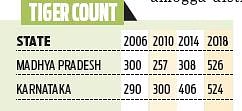
PM Narendra Modi, who launched a three-day mega event to mark 50 years of Project Tiger, is likely to declare Karnataka the ‘Tiger State of India’. As per a recent assessment by the National Tiger Conservation Authority (NTCA) and Wildlife Institute of India, it is expected that Karnataka has overtaken Madhya Pradesh in tiger population.
As per the 2018 tiger estimation, Karnataka came second with 524 tigers, while Madhya Pradesh with 526 tigers took first place. The country has 2,967 tigers, and efforts of forest officials in protecting wildlife and forests are expected to have increased the tiger population in the state and country.
The rapid increase in human population over the centuries led to a decline in wildlife in the country. There was large-scale hunting of wildlife, especially tigers, for pleasure during the period of the Mughals, Maharajas and Nawabs, as well as to save people from attacks of wild animals. During British rule between 1895 and 1925, it is reported that over 80,000 tigers, more than 1.50 lakh leopards and 2 lakh wolves were hunted in the country.
According to the Kanara District Gazetteer 1883, the British government gave incentives for killing tigers — Rs 24 for hunting an adult tiger, Rs 12 for a sub-adult tiger and Rs 6 for a tiger cub. As a result, in the 27 years between 1856 and 1882, 640 tigers were shot dead in Kanara, 158 tigers from 1856 to 1866, 350 tigers between 1867 and 1877, and 130 tigers between 1878 and 1882.
As per the 1954-55 Administrative Report of the forest department of the Government of Mysore, Kakanakote State Forest, Begur State Forest, Berambadi State Forest, Bandipur State Forest and Chamarajanagar State Forest in Mysore District, Lakkavalli State Forest in Chikkamagaluru District, Shankar State Forest in Shivamogga district and Hessaraghatta Grass Farm in Bengaluru district were declared game preserves, and Puduvakote Forest Block, Manche Gowdanahalli forest block and Bale Gowdananakatte forest block in Mysuru District, Gurupura forest block in Chikkamagaluru, Kadathikere and Devabu blocks in Shivamogga district were declared tiger preserves.
The first comprehensive legislation regarding wildlife protection was passed by Parliament and the President on September 9, 1972, called Wildlife Protection Act 1972. Then PM Indira Gandhi launched Project Tiger, providing assistance to states for tiger conservation.
However, before the WPL 1992, a number of wildlife sanctuaries — Venugopala Wildlife Park (1931), Ranganathittu Bird Sanctuary (1940), Bandipur Wildlife Sanctuary (1941) and Jagger Valley Wildlife Park (1951) in Mysore state, Nagarahole Wildlife Sanctuary (1955) in Coorg state and Dandeli Wildlife Sanctuary (1956) in Bombay Presidency — established by princely states were merged into Karnataka in 1956.
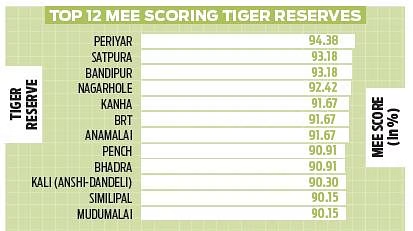
As per the Karnataka State Gazetteer, 1982, when Project Tiger was launched, Bandipur National Park was brought under it in 1973. Nagarahole National Park and Bhadra Wildlife Sanctuary were made tiger reserves in 1999. However, Dandeli Wildlife Sanctuary and Anshi National Park were brought under Project Tiger in 2007 under the name Dandeli-Anshi Tiger Reserve.
It was later renamed Kali Tiger Reserve. Biligiri Rangaswamy Temple (BRT) Wildlife Sanctuary was declared a tiger reserve in 2011. The forest department has sent a proposal to the central government to include Kudremukh National Park, Cauvery Wildlife Sanctuary and Male Mahadeshwara Hills Wildlife Sanctuary and Bhimgad Wildlife Sanctuary in Belagavi district in Project Tiger. Bhimgad Sanctuary is a critically important tiger corridor between Karnataka and Goa.
ACCURATE NUMBERS Former Mysuru honorary wildlife warden and Wildlife Conservation Foundation founder Rajkumar Devaraje Urs told TNIE that as tiger estimation was done based on pug marks in the past, there was no accuracy in counting tigers. “After camera traps were introduced, foresters achieved accuracy. The major threat to tigers is forest fires and poaching. If reserve foresters and island pockets are included in the tiger reserve, India has a chance to have a tiger population of 10,000 in future. If there is a good tiger population, forests will be healthy which increases rain, resulting in an increase in groundwater table and rivers.
90% of rivers originate in tiger reserves
As I conclude a memorable visit to the Bandipur and Mudumalai Tiger Reserves, I want to acknowledge the hard work of all forest officials, guards, tiger reserve frontline staff and everyone else working on tiger conservation. Words can’t do justice to their passion and effort. What a delight to meet the wonderful Bomman and Belli, along with Bommi and Raghu. — Prime Minister Narendra Modi
‘No conflict of economy, ecology’ Mysuru: Wildlife protection is a universal issue, said Prime Minister Narendra Modi on Sunday at the Karnataka State Open University convocation hall in Mysuru. Stating that India contributes to around eight per cent of the known global biodiversity, he said that India has not only saved the tiger population from declining but also provided an ecosystem where they can flourish, and was delighted that the tiger population has increased by 75 per cent. “India does not believe in a conflict between ecology and economy, and gives importance to their coexistence,” Modi said, adding, “India is a country where protecting nature is a part of our culture”. “India has the largest tiger range in the world, the largest Asiatic elephant range with around 30,000 elephants, and also the largest number of single-horn rhinos with a population of roughly 3,000,” he said. India’s Asiatic lion numbers have increased from around 525 in 2015 to around 675 in 2020, he said, adding that the leopard population has jumped by more than 60 per cent over 4 years.
Ramanji Nammabhoomi, Udupi was conferred with Bank of Baroda Achievers Award at Mangaluru University Syndicate auditorium on March 18 for his all-round achievements in the post graduate courses of Mangalore University.
Mangalore University vice-chancellor professor P Subrahmanya Yedapaditaya who conferred the award said that this handover has increased the award’s value. “The work of identifying talented persons by the Bank of Baroda is commendable,” he said.
Ramanji said that the award has inspired him to achieve more in the education sector. He expressed his gratitude for the award.
Bank of Baroda Konaje branch senior branch manager Derick D’ Souza, Mangalore University’s Dr Kishore Kumar C K, finance officer professor Y Sangappa, Professor Sadananda, Professor Kishori Nayak K and others were present.
Giridhar Salian, a government officer hailing from Kavoor Bolpugudde, has won a silver medal for India in the Javelin throw event (M60) at the World Masters Athletics Torun indoor championship 2023 in Torun, Poland.
The event will conclude on April 1st. Salian has served in various capacities as a government officer, including as deputy director and Grade-I principal at Government ITI Kadri Hills, Mangaluru, and as executive director at Karnataka Vocational Training and Skill Development Corporation (KVTSDC), Bengaluru.
He is also a nodal officer and deputy apprenticeship advisor for implementation of apprenticeship training in the district.
In addition to his professional accomplishments, Salian is a sportsman and has achieved medals at the district, state, national, and international level athletic meets in the Javelin throw event. He has represented India twice at the Asian Masters Athletic Championship and once at the World Masters Athletic Championship. Salian’s recent win follows his silver medal in the Javelin throw event at the 21st Asian Masters Athletics Championship in Kuching, Malaysia, in 2019.
Appe midi is a traditional pickling variety of mango from Karnataka, which is grown in the Malnad region of the State-especially in Sirsi, Sagara, Siddapur, Thirthahally, Kumata, Sakleshpur, Kodagu and Chikkamagaluru.
Thanks to the growing popularity of ‘appe midi ’ (tender mango in Kannada), the Indian Institute of Horticultural Research (ICAR-IIHR) in Hesaraghatta for the first time will conduct an exclusive ‘appe midi’ mango fair, where 100 varieties of such mangoes will be displayed.
Appe midi is a traditional pickling variety of mango from Karnataka, which is grown in the Malnad region of the State-especially in Sirsi, Sagara, Siddapur, Thirthahally, Kumata, Sakleshpur, Kodagu and Chikkamagaluru.
The fair will be held on April 12 and 13 on the IIHR campus in Hessarghatta.
Creating awareness
Speaking to The Hindu, M. Sankaran, Principal scientist, division of fruit crops, ICAR-IIHR, said, “Appe midi mangoes have a unique position with respect to the diversity of pickling mango varieties. Appe midi is the king of all tender mangoes as far as its use in the pickle industry is concerned. Since there is a demand and awareness has to be created on this variety of mangoes, we thought of conducting an exclusive fair.”
The IIHR will display 100 varieties of tender mangoes at the fair, which are preserved by IIHR and also grown by farmers in various parts of the State. “The custodian farmers from across the State will participate at the fair where 100 appe midi mango genotypes will be displayed. The pickle manufacturers will also sell their products made of tender mango. Apart from this, we will also distribute limited appe midi mango saplings to farmers,” Mr. Sankaran added.
According to IIHR, the pickles prepared from appe midi mangoes make for an exquisite culinary experience. The demand for pickles varies from 4,000 to 5,000 tonnes per year, translating to ₹100 crore per year.
Unorganised market
“A good quality tender mango costs ₹2 to 3; the price for a quintal could go up to almost ₹6,000, depending on demand and availability. Since the supply of appe midi meets only one-tenth of demand in the market, they are often mixed in with ordinary tender mangoes. This is not an organised market compared to others. Appe midi products have a high potential for marketing and need attention for conservation. The mango’s unique size and taste make its pickle one of the best in the country, with its fragrance so strong that adding just a few midis to an ordinary pickle can change its taste and smell,” Mr. Sankaran explained.
A wild appe midi tree can yield several tonnes of tender mango, with features varying from tree to tree. In Karnataka, 100 farm households are engaged in making appe midi pickles producing at least 100 tones of pickle a year. ICAR-IIHR has so far surveyed, collected and conserved more than 250 accessions of appe midi mangoes. These mangoes have a huge market in Goa, Tamil Nadu and Kerala, according to IIHR.
“The Poetry of G.M. Hopkins and Basavanna: A Comparative Study”, authored by Basavaraj P. Donur, Registrar, Central University of Karnataka, was released at Basava Samithi office in Bengaluru on Saturday.
“If Hopkins knew about Basavnna and his ideas he would have adopted Lingayat philosophy,” said Manu Baligar, member, Central Sahitya Academy, after the release of the work.
“Basavanna protested against the exploitative religious system and gave Lingayat philosophy and Hopkins also protested against the rigidity and orthodox practices of the Church of England. Though he lived in the 19th century, Hopkins’ ideas have a lot of similarities with that of Basavanna’s. It shows ideas of great thinkers always correlate and are timeless,” he said.
Dr. Baligar said that the work is meant for serious readers and suggested its translation into Kannada for taking it to a larger section of readers.
Central University Vice-Chancellor Battu Satyanarayana, faculty members Vikram Visaji, Ganapati Sinnoor, Siddanna Langoti, Prof. Donur and others were present.
The supercapacitor is fully functional and can be deployed in energy-storage devices like electric car batteries or any miniaturised system by on-chip integration.
Researchers at the Indian Institute of Science (IISc) have developed a new type of supercapacitor that can replace batteries in streetlights, electric cars and medical devices.
The supercapacitor, developed by researchers from IISc’s Department of Instrumentation and Applied Physics (IAP), is different from others, as it is smaller or ‘ultra-micro’, but capable of storing larger amounts of energy. Hence, the supercapacitor can be easier to use in smaller electronic devices, eliminating the need for batteries, while ensuring that the device stays charged for a longer time.
“Most of these devices are currently powered by batteries. However, over time, these batteries lose their ability to store charge and therefore have a limited shelf-life. Capacitors, on the other hand, can store an electrical charge for much longer, by their design. Supercapacitors, on the other hand, combine the best of both batteries and capacitors — they can store and release large amounts of energy, and are therefore highly sought-after for next-generation electronic devices,” the researchers said.
Abha Misra, an IAP professor and a corresponding study author, said the supercapacitor used Field Effect Transistors (FETs) instead of metallic electrodes, which are more commonly used, as charge collectors. “Using FET as an electrode for supercapacitors is something new for tuning charge in a capacitor,” she said.
During their tests, they found that the ultra-micro supercapacitor, due to the materials used, was able to increase capacitance (ability to store energy as electricity within the device) to 3,000 per cent. This was compared to a regular supercapacitor, which showed only an 18 per cent increase. The key was the use of molybdenum disulphide (MoS2) and graphene in increasing the mobility of electrons within the supercapacitor.
“In future, we are planning to explore if replacing MoS2 with other materials can increase the capacitance of the supercapacitor even more. The supercapacitor is fully functional and can be deployed in energy-storage devices like electric car batteries or any miniaturised system by on-chip integration. We are also planning to apply for a patent on the supercapacitor,” they said.
The Ministry of Defence has signed 10 contracts worth ₹5,498 crore with Bharat Electronics Ltd. (BEL) for the three armed forces.
BEL said the projects for the Indian Air Force include 90 EW Suite Equipment for Medium Lift Helicopter, annual maintenance contract for maintenance of two squadrons of the Akash Missile System. The Army projects include automated Air Defence Control and Reporting System (Project Akashteer) and Instant Fire Detection and Suppressing System (IFDSS) for T72 tanks. The Navy projects include 1265 Software Defined Radios, 1178 HDVLF HF Receivers, 12 Sarang’s for Kamov 31 helicopters, INS-SA, CMS for P17 & P28, and Varuna EW system
“These are flagship projects showcasing the indigenous design and manufacturing capabilities of the Indian Defence industry led by BEL, involving other public sectors, private sectors, and MSMEs. The projects will add another milestone to the ‘Make in India’ initiative of the Government of India,” said BEL.